Film productions fall into several distinct categories: feature films, documentaries, TV and episodic series, commercials, music videos, corporate videos, short films, and branded content. Each type operates with different crew sizes, timelines, facility needs, and budget structures. What they all share is the need for connected studio management software that handles scheduling, equipment tracking, crew coordination, budgeting, and media asset management in one platform.
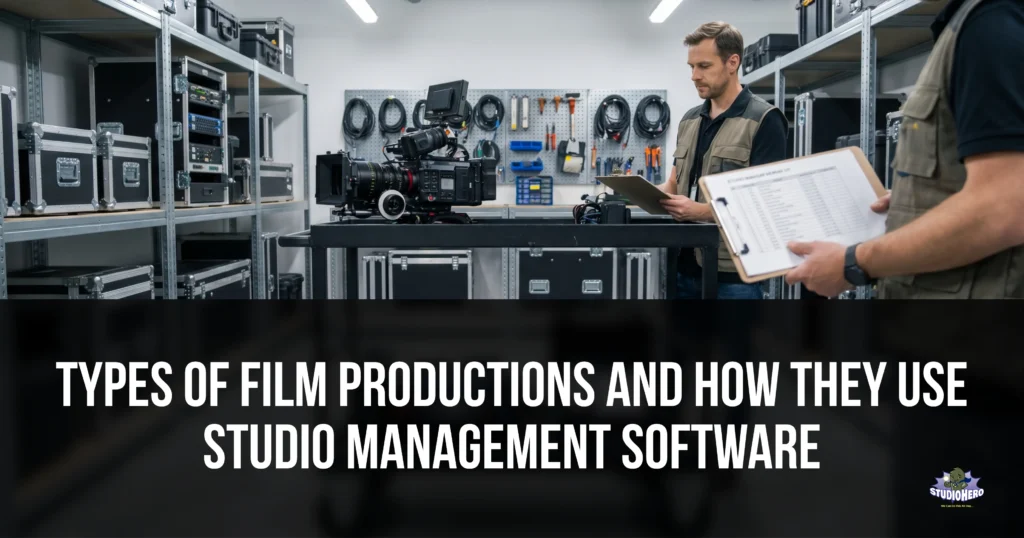
At Studio Hero, we built our platform around the operational reality of running a production studio, not around project templates borrowed from generic software.
This guide breaks down the major types of film and video productions, what makes each one operationally distinct, and how StudioHero supports the workflows that keep them on schedule and on budget.
What Are the Main Types of Film Productions?
Film and video production is not one category. It is a collection of production formats, each with its own crew structure, budget model, timeline, and facility requirements. Understanding these differences matters because the operational demands of each type determine what you need from your production management tools.
Here is a quick overview of the major production types and what sets them apart operationally:
| Production Type | Typical Crew Size | Average Duration | Key Facility Needs | Primary Management Challenge |
| Feature Film | 50-300+ | 3-12 months | Sound stages, edit suites, color rooms | Multi-department coordination across long timelines |
| Documentary | 2-25 | Weeks to years | Minimal studio, heavy location | Unpredictable scheduling and evolving scope |
| TV/Episodic | 40-200 | Recurring seasons | Permanent stages, control rooms | Repeating workflows with tight turnaround |
| Commercial/Advertising | 15-80 | 1-5 days | Studio stages, props storage | Fast setup, high gear turnover, client approvals |
| Music Video | 5-40 | 1-3 days | Studio or location | Rapid turnaround, creative flexibility |
| Corporate/Industrial | 3-20 | 1-10 days | Conference rooms, offices, small studios | Multi-stakeholder review, brand compliance |
| Short Film/Independent | 3-30 | 1-4 weeks | Shared or rented spaces | Limited budget, borrowed or rented gear |
| Branded Content/Web Series | 5-25 | Ongoing/episodic | Small studios, home setups | Consistent output cadence, content calendar management |
Each of these production types creates specific operational pressure on scheduling, equipment tracking, crew management, budgeting, and asset handling. Let us walk through each one and how Studio Hero fits into their workflow.
Feature Film Productions
Feature films are the most complex production type in the industry. A single feature can involve hundreds of crew members across departments like camera, grip, electric, art, wardrobe, sound, visual effects, and post-production. Shoots span weeks to months, often across multiple locations and studio stages simultaneously.
What Makes Feature Films Operationally Complex
The challenge is not just size. It is coordination across departments that all depend on each other. The camera department cannot shoot until the art department finishes the set. The grip team cannot rig lighting until the gaffer confirms the power distribution plan. The sound department needs quiet, which conflicts with construction happening on the adjacent stage.
This cascading dependency is why feature film productions need studio scheduling software that shows real-time availability for stages, edit suites, crew, and gear in a single calendar view, not separate spreadsheets per department.
How Studio Hero Supports Feature Films
- Multi-resource scheduling: We let you book sound stages, color suites, ADR rooms, and Foley stages with linked reservations so that reserving a stage automatically holds the associated lighting grid and camera package. Learn more about studio scheduling best practices.
- Crew database and availability tracking: Our crew management module maintains a searchable directory of cast, crew, freelancers, and vendors with day rates, union affiliations (SAG-AFTRA, IATSE), and availability across overlapping productions. We track scheduled vs. actual hours so you catch overtime before it hits payroll. For common pitfalls in staffing, see crew scheduling conflicts in film and video production.
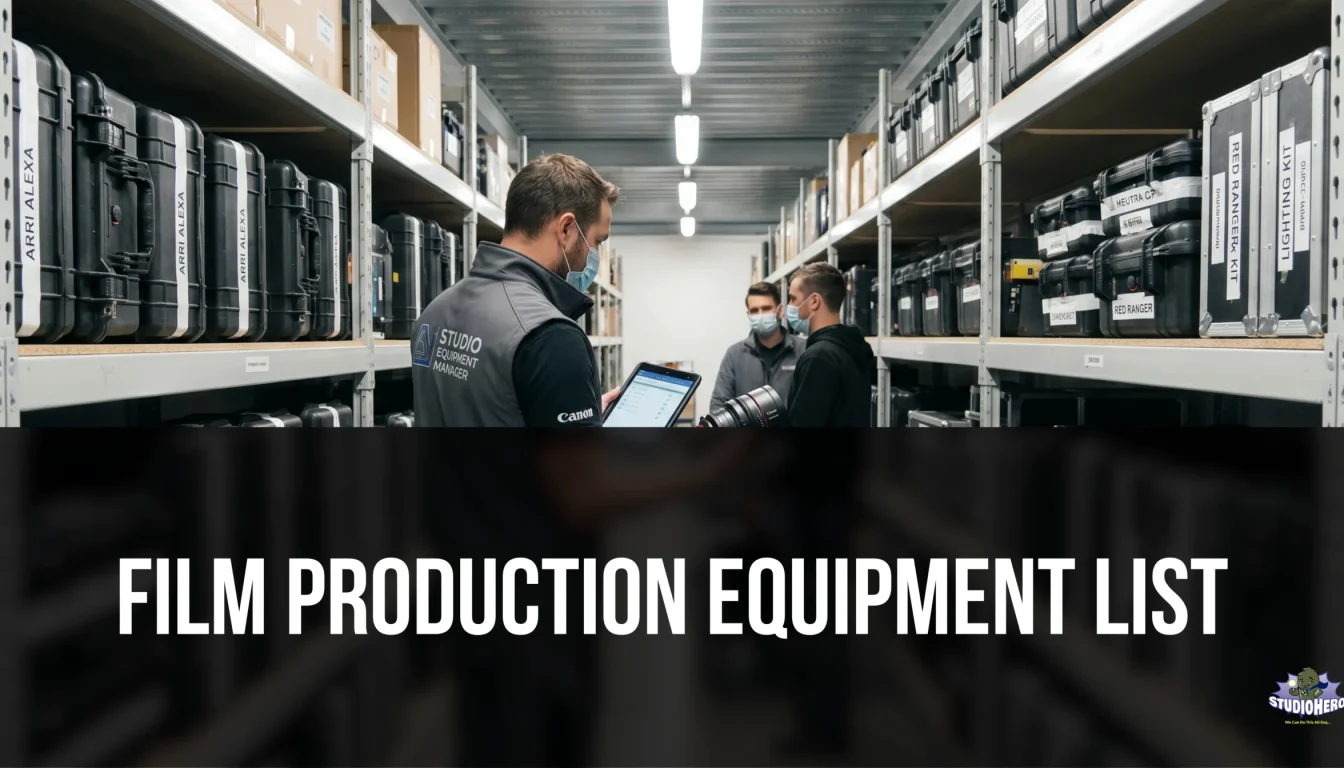
- Equipment tracking with check-in/check-out: Camera packages, lenses, audio kits, grip gear, and expendables move between stages, trucks, and locations daily. Our equipment tracking module logs every movement with barcode scanning, usage history, and maintenance flags. See also the guide onequipment tracking problems creative studios face daily.
- Budget monitoring at department level: Feature film budgets can run from low six figures to nine figures. Studio Hero’s budgeting tools track planned vs. actual spend at the department, episode, or full-production level so you spot overruns before they become conversations with the executive producer. Related reading:studio financial management best practices.
- Media asset organization: Scripts, storyboards, shot lists, dailies, rough cuts, and final deliverables need a central home. Our media asset management module attaches files directly to production events, keeping everything searchable and version-controlled.
Documentary Productions
Documentaries operate on a fundamentally different rhythm than scripted productions. There is no locked script. Shoots happen when the subject is available or when events unfold. Crew sizes are small but timelines stretch, sometimes across years.
What Makes Documentaries Operationally Distinct
The biggest challenge is unpredictability. A documentary crew might plan a two-day shoot that turns into two weeks because the story evolved. Equipment lists change mid-production. Interview subjects cancel, reschedule, or become available with 24 hours notice.
Spreadsheet-based planning breaks down fast when the production plan changes weekly. Documentary producers need a flexible system that tracks what is happening now while keeping a record of what already happened.
How Studio Hero Supports Documentaries
- Flexible scheduling with drag-and-drop adjustments: When your plans change, the schedule needs to change with them. Studio Hero’s calendar supports multi-day continuous events, recurring blocks, and fast rescheduling without re-entering booking details from scratch.
- Location and gear tracking across shoots: Documentary crews often carry a core equipment package to different locations over months. Our inventory management module tracks what gear is out, what condition it is in, and when maintenance is due, even when your crew is working remotely.
- Simple invoicing for freelance crew: Documentary teams frequently hire local fixers, translators, camera operators, and sound recordists per shoot. Our invoicing module generates invoices tied to specific shoot dates and crew records, keeping financial documentation clean for grant reporting or distributor audits.
- Media organization across long timelines: A documentary shot over 18 months accumulates terabytes of footage, transcripts, releases, and legal documents. Having a structured media asset management system prevents your post-production team from wasting weeks hunting for specific interview clips or B-roll.
TV and Episodic Productions
Television and episodic productions combine the scale of feature films with the pace of a factory floor. Seasons run on tight schedules. Episodes overlap in production, meaning one episode is shooting while another is in post and a third is in pre-production simultaneously.
What Makes TV Production Operationally Demanding
The repeating cycle creates a unique management challenge. Unlike a feature film with a single arc from pre to post, episodic productions run multiple concurrent workflows. The same sound stage needs to be prepped, shot, and struck on a rotating schedule. The same crew works across episodes with shifting assignments. Equipment circulates between departments constantly.
This is where production management software designed for ongoing operations outperforms project-based tools. See also: how to manage a production studio efficiently.
How Studio Hero Supports TV Productions
- Recurring schedule templates: We support weekly shooting blocks, recurring edit suite reservations, and repeating crew assignments that carry across the season. Our studio scheduling supports continuous event scheduling so your production coordinators do not recreate the same bookings every week.
- Permanent stage and control room management: TV productions often hold stages for entire seasons. Each room in Studio Hero carries a digital profile including dimensions, power outlet ratings, installed rigging, console specs, acoustic treatment, and attached photos. Department heads know exactly what each space offers before call time. This is part of our studio equipment management approach.
- Crew rotation and overtime tracking: With crews working across multiple episodes, tracking scheduled vs. actual hours prevents overtime surprises. Our crew management module compares planned call times against actual wrap times, helping with payroll accuracy and union compliance. For deeper strategies, read crew management best practices.
- Rolling budget tracking: Episode budgets need to roll up to season totals. Studio Hero’s budgeting module lets you monitor costs at the episode, department, and season level with live updates as charges land.
Commercial and Advertising Productions
Commercial productions are short, intense, and high-pressure. A 30-second spot might require three days of shooting with a crew of 60, multiple camera setups, agency supervision, and client approvals at every stage. The margin for error is thin because the budget is fixed and the delivery date does not move.
What Makes Commercial Production Operationally Intense
Speed and client oversight define commercial production operations. Sets need to be built and struck in hours. Equipment lists are extensive because multiple camera angles, specialized lighting rigs, and product hero shots demand precision gear. Agency creatives and brand managers need real-time visibility into progress without being on set.
How Studio Hero Supports Commercial Production
- Fast resource booking with linked reservations: When you book a stage for a commercial shoot, the associated lighting grid, camera package, and grip gear follow automatically through our studio scheduling linked booking feature.
- Client portal for approvals and deliverables: Agency teams and brand clients need to review concepts, approve edits, and access final files without calling your production coordinator. Our client booking portal provides a branded workspace where clients submit requests, review assets, and approve deliverables. For more on managing client expectations, see studio client management best practices.
- Rapid invoicing and PO management: Commercial productions often involve multiple vendors, talent agents, and rental houses on short payment terms. Our invoicing module creates invoices tied to specific productions and tracks outstanding payments. Related: how to improve podcast studio cash flow with billing software covers billing workflow strategies that apply across production types.
- Equipment turnaround tracking: Gear moves in and out of the studio rapidly during commercial shoots. Our equipment tracking module with barcode scanning logs check-in, check-out, and condition at every handoff, preventing the “who had the C-stand last?” problem. Read more in the ultimate guide to equipment management, tracking and maintenance.

See StudioHero in Action
Book a personalized walkthrough for your studio.
Music Video Productions
Music videos sit between commercials and short films in terms of scale. Crews are small to medium. Timelines are tight, typically one to three shooting days. But the creative ambition often outpaces the budget, which means every resource needs to be used efficiently.
What Makes Music Video Production Different
Creative flexibility drives music video operations. Setups change frequently within a single shooting day. Locations might shift from a studio stage to an exterior to a rooftop within hours. Equipment needs vary widely depending on the visual concept, from steadicam rigs to drones to specialized lighting packages.
How Studio Hero Supports Music Videos
- Quick-setup scheduling: Our scheduling tools let you build a shoot day plan with time-blocked setups, each tied to specific gear and crew, without building an entire multi-week production plan.
- Gear package management: Music video producers often rent specialized equipment for a single shoot. Our inventory management module tracks what is owned vs. rented, what is checked out, and what needs to be returned by when. For common issues with shared equipment, see shared equipment tracking mistakes.
- Budget tracking on small margins: Music video budgets are typically tight. Having real-time budget vs. actual tracking through our budgeting module helps you make trade-off decisions on set instead of discovering overruns in post.
- Simple invoicing for quick payments: Labels and management companies often expect invoices within days of wrap. Our invoicing module generates professional invoices tied to production records for fast turnaround.
Corporate and Industrial Video Productions
Corporate video production covers a wide range: training videos, internal communications, product demos, event coverage, investor presentations, safety compliance videos, and brand films. The production quality expectations have risen significantly, but the operational structure is usually leaner than entertainment production.
What Makes Corporate Production Unique
Multi-stakeholder review processes and brand compliance define corporate production. Multiple departments (marketing, legal, HR, executive leadership) often need to approve content before it ships. Revisions are common. Deadlines are tied to business events like product launches, earnings calls, or conferences.
How Studio Hero Supports Corporate Productions
- Client portal for internal stakeholders: When the “client” is an internal department, our client booking portal serves as a self-service request and review system. Marketing submits a video request, your production team schedules it, stakeholders review edits, and final files are delivered through the same portal.
- Room and resource scheduling for in-house studios: Many corporations operate internal video studios. Our studio scheduling manages room bookings, teleprompter availability, backdrop setups, and crew assignments for in-house production teams.
- Asset management for compliance: Corporate videos often have legal, compliance, and brand requirements attached to them. Our media asset management module keeps approved logos, lower thirds, brand guidelines, talent releases, and final masters organized and accessible.
- Budget tracking and reporting: Internal production teams often need to justify their costs. Studio Hero’s budgeting tools generate cost reports that show spend per project, helping in-house teams demonstrate ROI to leadership.
Short Films and Independent Productions
Independent productions run on limited budgets, borrowed or rented equipment, and small crews who often wear multiple hats. A producer on a short film might also be the line producer, the location manager, and the person driving the equipment truck.
What Makes Independent Production Challenging
Budget constraints force independent producers to maximize every resource. There is no margin for double-bookings, lost gear, or missed vendor payments. But the tools available to indie producers are often either too expensive (enterprise production management platforms) or too generic (general project management software that does not understand production workflows).
How Studio Hero Supports Independent Productions
- Affordable all-in-one platform: Instead of paying for separate scheduling, equipment tracking, invoicing, and budgeting tools, Studio Hero brings all of this into one connected platform. For a comparison of available options, see how to choose studio management software.
- Equipment tracking for rented and borrowed gear: You need to track who has what, when it is due back, and what condition it is in. Our equipment tracking module handles this even for gear that is not owned by the production.
- Crew management with rate tracking: Managing freelancers on day rates with different payment terms is simpler when every crew member has a profile with their rate, invoice history, and availability. Our crew management module does this without requiring enterprise-level onboarding. For related guidance, see manage freelance crews.
- Simple budgeting and invoicing: Keeping track of where money goes is critical when the budget is $15,000 instead of $15 million. Our budgeting and invoicing modules are built for real production accounting, not enterprise financial software complexity.
Branded Content and Web Series
Branded content and web series production has grown rapidly as brands invest in long-form storytelling and platforms like YouTube, TikTok, and social channels demand regular content cadence. These productions often operate as ongoing operations rather than one-off projects.
What Makes Branded Content Production Different
The ongoing nature changes the management challenge. Instead of one production with a start and end date, branded content teams manage a content calendar with weekly or monthly deliverables. Equipment stays in-house. Crew rotations are regular. The studio operates more like a media company than a film production.
How Studio Hero Supports Branded Content
- Content calendar through recurring scheduling: Our scheduling module supports recurring booking patterns that match your content production cadence, weekly studio time, bi-weekly edit sessions, monthly review meetings. This aligns with studio scheduling best practices for high-output operations.
- Ongoing inventory management: When your studio owns its equipment and uses it daily, tracking condition, maintenance schedules, and replacement timelines becomes critical. Our inventory management module provides this ongoing visibility. Learn more about avoiding common issues in inventory management mistakes.
- Consistent invoicing for retainer clients: Branded content teams often bill on retainer or per-deliverable. Our invoicing module supports recurring billing tied to production records.
- Centralized asset library: A web series that runs for 50 episodes generates thousands of files. Our media asset management module keeps everything organized by project, episode, and asset type.
How to Choose the Right Studio Management Setup for Your Production Type
Choosing the right software is not about finding the most features. It is about finding the best fit for the way your productions actually run.
A commercial production company may prioritize approvals and rapid scheduling. A feature film studio may need strong budgeting and multi-department visibility. An animation or VFX studio may care most about shot tracking and revision workflows.
When evaluating studio management software, ask:
- What kind of productions do we run most often?
- Where does our day-to-day chaos happen?
- Which workflows are still managed in spreadsheets, chat, or email?
- Which teams need shared visibility?
- Do we need scheduling, budgeting, assets, approvals, or all of the above?
The best studio management software supports your production model, improves team coordination, and creates a single source of truth for operations.
Final Takeaway
Different types of film productions use studio management software to solve different kinds of complexity.
- feature films and series use it for scale, planning, and coordination
- commercials and music videos use it for speed and approvals
- documentaries use it for flexibility and logistics
- animation and VFX use it for pipeline visibility and revision control
- post-production teams use it for resource booking and delivery tracking
The more your production model depends on changing schedules, shared resources, approvals, and cross-functional visibility, the more valuable studio management software becomes.
If your team is juggling projects through spreadsheets, chat threads, and disconnected tools, a centralized system can make production operations far easier to manage.
Ready to Manage Your Studio Operations?
Studios across film, podcast, recording, broadcast, and photography trust StudioHero.
Frequently Asked Questions
The main types include feature films, documentaries, TV and episodic series, commercials and advertising, music videos, corporate and industrial videos, short films and independent productions, and branded content or web series. Each type has distinct crew sizes, timelines, budget structures, and facility requirements that affect how they manage operations. Studio Hero’s film and video production management software adapts to the operational demands of each type.
We centralize your core operational workflows: scheduling stages, rooms, and crew; tracking equipment with barcode check-in and check-out; managing your crew database with rates and availability; monitoring budgets with live spend tracking; and organizing media assets in a searchable library. Everything connects in one platform so your production team stops switching between disconnected tools.
Yes, especially for long-duration shoots. Documentary crews deal with unpredictable scheduling, equipment that travels across locations for months, freelance crew hired per shoot, and media assets that accumulate over long timelines. Studio Hero handles flexible scheduling, gear tracking, invoicing, and asset management without requiring enterprise-level complexity.
Production management software typically focuses on the creative production pipeline: script breakdown, stripboard scheduling, call sheets, and shot lists. Studio management software manages the facility and operational side: room and stage scheduling, equipment tracking, crew coordination, invoicing, budgeting, and client management. For productions that operate out of a studio or facility, both layers are needed. Studio Hero covers the operational side. For more on this distinction, see studio management vs production management.
Absolutely. Independent productions actually have less room for operational mistakes because budgets are tighter. Tracking rented equipment, managing freelancer payments, scheduling shared spaces, and monitoring a limited budget are all easier with our connected platform than with spreadsheets and email. See our pricing for available plans.
Our equipment tracking module logs every piece of gear with barcode scanning, check-in/check-out records, usage history, condition notes, and maintenance scheduling. Whether the gear is owned, rented, or borrowed, we track who has it, where it is, and when it needs to come back. For a deeper look at equipment operations, read take control of every piece of gear with Studio Hero’s equipment management module.
Feature films, TV series, and commercial productions benefit the most because their scale creates the highest risk of disconnected information. When scheduling and budgeting are linked, booking a stage or a crew member automatically reflects in the production budget. This live connection prevents cost surprises and gives you accurate financial visibility throughout the production. Studio Hero’s studio finance management ties these systems together.
By moving scheduling, equipment, crew, invoicing, budgeting, and asset management into a single platform designed for studio operations. Studio Hero replaces the patchwork of spreadsheets, shared drives, and email threads that most production studios still rely on. For a practical walkthrough of this transition, read centralize studio operations without spreadsheets.
Ready to bring your production operations into one platform?
Book a demo to see how Studio Hero handles the scheduling, equipment, crew, budgeting, and asset management that every film and video production needs. Or check out our pricing page to find the right plan for your studio.
Studio Hero is studio management software built for film, TV, audio, video, podcast, and photography production studios. See pricing or book a free demo.