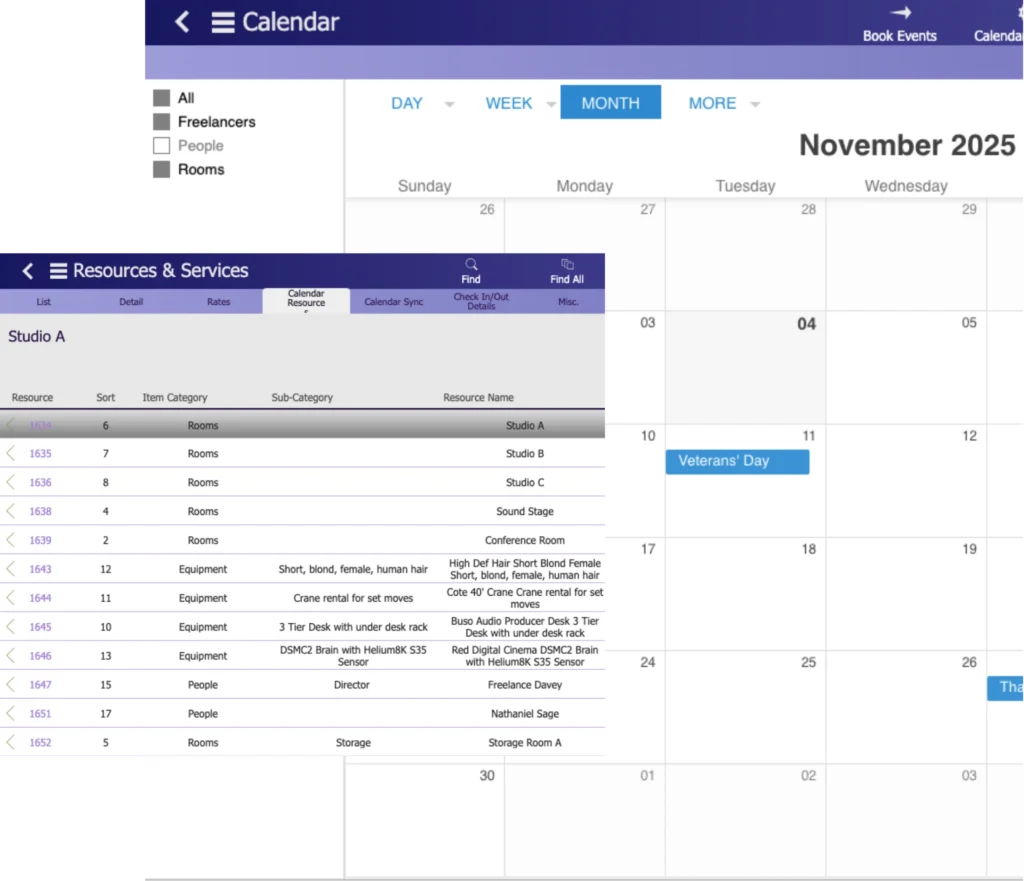
If your film production studio is losing time to scheduling conflicts, budget reconciliation errors, equipment accountability gaps, or crew communication breakdowns across multiple productions, these are not isolated operational problems. They are symptoms of a fragmented management system that has outgrown its infrastructure. This guide covers the specific signs that tell you it is time to move to an all-in-one studio management tool, and what that shift actually looks like in practice.
The Real Cost of Running a Film Studio on Disconnected Tools
Most film production studios do not start with a fragmented system. They start with a spreadsheet that works, a calendar that covers scheduling, an email thread that handles crew communication, and a folder structure that organizes assets. These tools work at a certain scale. Then the studio takes on a second simultaneous production, then a third, and the cracks appear.
The problem is not that these tools are bad. The problem is that they were never designed to talk to each other. When your scheduling data lives in one place, your crew availability in another, your equipment inventory in a third, and your budget in a fourth, every operational decision requires manual cross-referencing across all four. At scale, that manual overhead becomes the biggest operational cost your studio carries, and it is entirely invisible on a budget sheet.
Studio operations management built on disconnected tools does not just slow your team down. It creates the conditions for the kind of operational failures that cost real money on real productions.
Sign 1: Your Scheduling Lives in Multiple Places
If your production schedule exists in a shared spreadsheet, your crew availability is tracked in a separate document, your equipment calendar is maintained by a department head in their own system, and your facility bookings are managed through email confirmation, you do not have a scheduling system. You have four separate information sources that are guaranteed to contradict each other at the worst possible moment.
The specific failure this creates in a film production studio is a conflict that no single person can see because no single person has visibility of all four sources simultaneously. A crew member gets double-booked across two productions because the person scheduling Production A has no visibility of the commitments already made by Production B. A camera package gets assigned to two units on the same shooting day because equipment allocation and production scheduling are managed in separate tools.
These are not human errors. They are system failures. A studio scheduling system that connects crew availability, equipment allocation, and facility bookings to the production calendar in one place makes these conflicts structurally impossible, because the conflict is flagged at the point of scheduling, not discovered on the day it causes a problem.
If your production coordinators spend part of every day manually cross-referencing multiple sources to check for conflicts that should surface automatically, your studio needs an all-in-one management tool.
Sign 2: Crew Conflicts Surface on Set, Not in Pre-Production
There is a version of a crew scheduling conflict that is manageable: it surfaces during pre-production planning when there is still time to adjust. There is a version that is expensive: it surfaces on the morning of a shoot when the crew member in question is already committed elsewhere and there is no time to find a replacement.
If your studio consistently experiences the second version, the root cause is almost always a crew management system that does not have real-time visibility of all active production commitments. When crew availability is tracked per-production rather than across all productions simultaneously, the conflict between two productions is invisible to both production teams until it becomes a set emergency.
Crew management in an all-in-one studio management tool maintains a single crew availability record that updates across all active productions the moment a commitment is made. Every production team works from the same crew availability data, so conflicts are caught during scheduling, not during shooting.
Crew scheduling conflicts in film and video production that consistently surface on set rather than in pre-production are a direct indicator that your crew management and scheduling systems are not connected.
Sign 3: You Cannot Tell Where Your Equipment Is Right Now
On any given day in an active film production studio, equipment is on set, in transit, in the equipment room, out for maintenance, on loan to a second unit, or with a rental house awaiting return. If someone asks you right now where your primary camera package is, how long it takes you to answer that question tells you a great deal about your equipment management system.
If the answer requires a phone call to a department head, a check of a spreadsheet that may not have been updated since yesterday, or an email to the production coordinator, your equipment tracking system is not a system. It is a collection of manual checks that approximates a system when everyone remembers to update their part of it.
Equipment tracking in a professional film production studio should be a real-time function, not a manual reconciliation process. Every piece of equipment should have a known status, a known location, a known assignment, and a known return date that is visible to anyone with appropriate access without requiring a phone call.
Shared equipment tracking mistakes between productions running simultaneously are among the most avoidable and most expensive operational failures in multi-project studios. An all-in-one studio management tool with connected studio equipment management eliminates these failures by making equipment status visible across all productions in real time.
If your answer to “where is the equipment right now” takes more than thirty seconds, this is a sign your studio needs a better system.
Sign 4: Your Budget Position Is Always a Few Days Behind Reality
Film production budget management has a specific failure mode that is unique to the production environment. Costs are committed on set days before the invoice arrives. Petty cash is spent before it is reconciled. Crew overtime accumulates before it appears in the accounts. By the time the cost report reflects the true financial position of a production, the production has already committed to additional spend based on outdated information.
If your Line Producers are making scheduling and resource decisions based on a budget report that is three days old, they are not managing the budget. They are reacting to historical data while the actual financial position continues to move.
Real-time studio budgeting connects actual expenditure, committed costs, and petty cash reconciliation to one live financial view that reflects the true budget position on any given day. When a crew overtime threshold is crossed, it appears in the budget immediately. When a petty cash float is reconciled, the actual figure updates the production’s cost report without waiting for a manual entry cycle.
Studio finance management that operates within the same platform as scheduling and crew management means that cost commitments made during scheduling are reflected in the budget the moment they are confirmed, not days later when the invoice arrives.
If your production financial reports consistently reflect where you were rather than where you are, your studio needs an all-in-one management tool with connected budget tracking.
Sign 5: Invoicing and Payments Are Managed Through Email Chains
Freelance crew members, equipment rental houses, location owners, catering companies, and post-production vendors all need to be paid on schedules tied to contractual terms. If the process for managing these payments involves tracking invoice status through email threads, maintaining a payment schedule in a separate spreadsheet, and chasing approvals through informal communication channels, the administrative overhead is significant and the error rate is higher than it needs to be.
Missed payment deadlines damage the studio’s relationships with the freelance and vendor community it depends on for every production. Duplicate payments, missed invoices, and unapproved expenditure all represent direct financial losses that a structured invoicing system eliminates.
Studio invoicing within an all-in-one management tool connects purchase orders to invoices to payments with clear approval workflows, status tracking across all active productions, and automatic reflection of every processed payment in the production’s financial position.
If your accounts team spends significant time each week reconciling payment status across email threads and spreadsheets, this is a direct sign that your studio’s invoicing function needs to be brought into a connected management system.

See StudioHero in Action
Book a personalized walkthrough for your studio.
Sign 6: Post-Production Asset Management Is a Folder Structure on a Shared Drive
A shared drive folder structure is not a media asset management system. It is a storage solution with a naming convention that works until someone saves a file with the wrong name, saves it in the wrong folder, or distributes an outdated version to a downstream department.
In a film production studio managing multiple projects simultaneously through post-production, the asset management risk is compounded. Multiple editors working on different productions on the same shared drive, VFX deliverables arriving from external vendors and being placed in folders maintained by different team members, and music stems being distributed to sound mixers from different versions of the same session all create version confusion that costs real post-production time to untangle.
Media asset management in an all-in-one studio management tool maintains project-level separation, version control, access permissions, and deliverable tracking in a structured system rather than relying on everyone correctly following a folder naming convention under time pressure.
Production tracking gaps in post-production are consistently traced back to the absence of structured asset management. If your post-production supervisors spend time each week tracking down the current version of an asset that should be immediately locatable, your studio needs a proper asset management system.
Related Reading:
- Why Film Production Studios Need More Than Project Management Software
- What to Look for in Film Production Studio Management Software
- Film Production Studio Operations Checklist for Multi-Project Teams
- Crew Scheduling Conflicts in Film and Video Production
- Film Production Equipment List
Managing multiple productions, crews, schedules, and equipment? Explore Studio Hero’s film and video production management software.
Sign 7: Studio Leadership Has No Real-Time View Across All Active Productions
A studio operations manager or executive producer responsible for multiple simultaneous productions needs one thing above everything else: visibility. The ability to see the current status of every active production, its schedule adherence, its budget position, its crew and equipment commitments, and its upcoming milestones, from one view, without compiling a manual report from multiple sources.
If getting this view requires collecting updates from multiple Line Producers, consolidating spreadsheets from different production teams, and waiting for end-of-week reports that are already out of date by the time they are compiled, your studio’s leadership is operating with a structural information deficit.
Studio operations metrics that matter to studio leadership, including schedule adherence across productions, budget variance by project, crew utilization rates, and equipment availability, should be visible in real time within the same system that production teams use for their daily operational work. When operational data is entered once and visible everywhere, studio leadership always has an accurate picture of what is happening across every active production without requiring a reporting cycle.
Studio-level dashboard and cross-production visibility tools for film production companies represent the operational oversight capability that separates studios that scale with control from those that scale reactively.
Sign 8: Your Team Is Running the Same Manual Processes on Every New Production
Every time a new production starts, does your team rebuild the same spreadsheets from scratch? Re-enter the same crew contacts into a new document? Set up the same folder structure on the shared drive? Recreate the same budget template they used on the last production?
This is one of the clearest signs that your studio lacks operational infrastructure. When every new production requires rebuilding the management system from zero, the studio never accumulates operational efficiency. Every production carries the same setup overhead, the same learning curve, and the same risk of missing something that was missed on the last production for the same reason.
An all-in-one studio management tool builds operational infrastructure that persists across productions. Crew records carry forward. Equipment inventory is maintained continuously. Budget templates reflect the studio’s standard cost architecture. Scheduling workflows follow established patterns rather than being reinvented for each project.
The studio management checklist that a studio needs to execute at the start of every production should be a system-guided process, not a manual effort that depends on institutional memory.
Sign 9: Communication Breakdowns Are Causing Operational Failures
If the most common root cause of operational problems in your studio is “someone didn’t get the message,” the problem is not the people. It is the communication infrastructure. When production information is distributed across email, messaging apps, phone calls, and verbal briefings, critical updates fail to reach the people who need them.
A location change communicated by email but not reflected in the scheduling system means crew arriving at the wrong location. A schedule adjustment shared in a group message but not updated in the call sheet means departments preparing for scenes that are no longer shooting that day. An equipment return communicated verbally but not logged in the inventory system means the next production being told gear is available when it is not.
An all-in-one production management tool makes operational changes visible across the system the moment they are entered, rather than relying on cascading manual communication to keep every department updated. When the schedule changes in the system, every connected team member sees the updated schedule. When equipment is returned and logged, its availability updates immediately for all productions.
Centralized production communication and operational update workflows for film studios is the system design principle that eliminates the communication-driven operational failures that cost studios time and money on every production.
Sign 10: You Are Scaling Up But Control Is Scaling Down
The clearest sign of all. Your studio is taking on more productions, more crew, more equipment, and more clients. Revenue is growing. And simultaneously, your operational control is getting looser, not tighter. More conflicts are surfacing. More budget variances are appearing. More things are falling through the cracks.
This is what scaling on fragmented tools looks like. Each additional production adds another layer of manual coordination to a system that was already at its operational limit. The tools that worked for one production create compounding complexity at three productions, and the studio pays for that complexity in operational failures, staff time, and client relationship damage.
Studio Hero is the all-in-one film and video production management software built specifically for film, TV, video, and creative production studios that are scaling and need their operational control to scale with them. Every module, from crew management and equipment tracking to studio budgeting and media asset management, is connected within one platform so that adding a new production adds operational visibility, not operational complexity.
Conclusion
The signs in this guide are not theoretical. They are the operational patterns that film production studios experience when they have grown beyond the tools they started with. Scheduling conflicts that surface on set. Budget reports that reflect history rather than reality. Equipment that cannot be located without a phone call. Post-production assets managed through folder naming conventions. Studio leadership operating without real-time visibility across active productions.
Each of these signs points to the same underlying problem: a management system built from disconnected tools that cannot share data, cannot surface conflicts automatically, and cannot give your studio the single operational view it needs to run multiple productions with confidence.
Studio Hero gives film production studios the all-in-one operational infrastructure to manage every production function in one connected system. When your scheduling, crew, equipment, budgets, invoicing, and assets all operate from the same platform, the signs on this list stop being recurring problems and start being historical ones.
Ready to Manage Your Studio Operations?
Studios across film, podcast, recording, broadcast, and photography trust StudioHero.
Frequently Asked Questions
An all-in-one studio management tool for film production is a platform that centralizes scheduling, crew management, equipment tracking, budget management, invoicing, and media asset management within one connected system. Unlike point solutions that address individual workflow functions in isolation, an all-in-one platform connects all operational functions so data entered in one area is immediately visible across every other area.
The clearest indicators are scheduling conflicts that surface on set rather than in pre-production, budget reports that are consistently behind actual financial position, equipment that cannot be tracked in real time, post-production asset management relying on shared drive folder structures, and studio leadership lacking real-time visibility across all active productions simultaneously.
A studio can run multiple productions on spreadsheets and disconnected tools up to a certain scale. Beyond that point, the manual coordination overhead required to maintain visibility across all active productions becomes the studio’s biggest operational cost, and the conflict rate, both scheduling and financial, increases with every additional production added.
Production management software is built around the specific operational logic of film and video production, including shooting schedule structures, above-the-line and below-the-line budget architecture, equipment package allocation, crew turnaround compliance, and multi-project resource management. General project management tools require significant configuration to approximate these functions and cannot replicate the purpose-built operational depth that professional film production requires.
An all-in-one studio management tool maintains a single crew availability record that updates across all active productions in real time. When a crew member is assigned to a shooting day on one production, their availability is immediately reflected across all other productions in the system, making double-booking structurally impossible rather than dependent on manual cross-referencing.
Post-production asset management within an all-in-one platform replaces unstructured shared drive folder systems with a structured environment that maintains project-level separation, version control, access permissions, and deliverable tracking. Post-production supervisors spend time managing the pipeline rather than tracking down current asset versions across folders maintained by different team members.
SEE STUDIO HERO IN ACTION
Run every production from one place.
Coordinate schedules, crews, equipment, budgets, and projects without relying on disconnected tools.