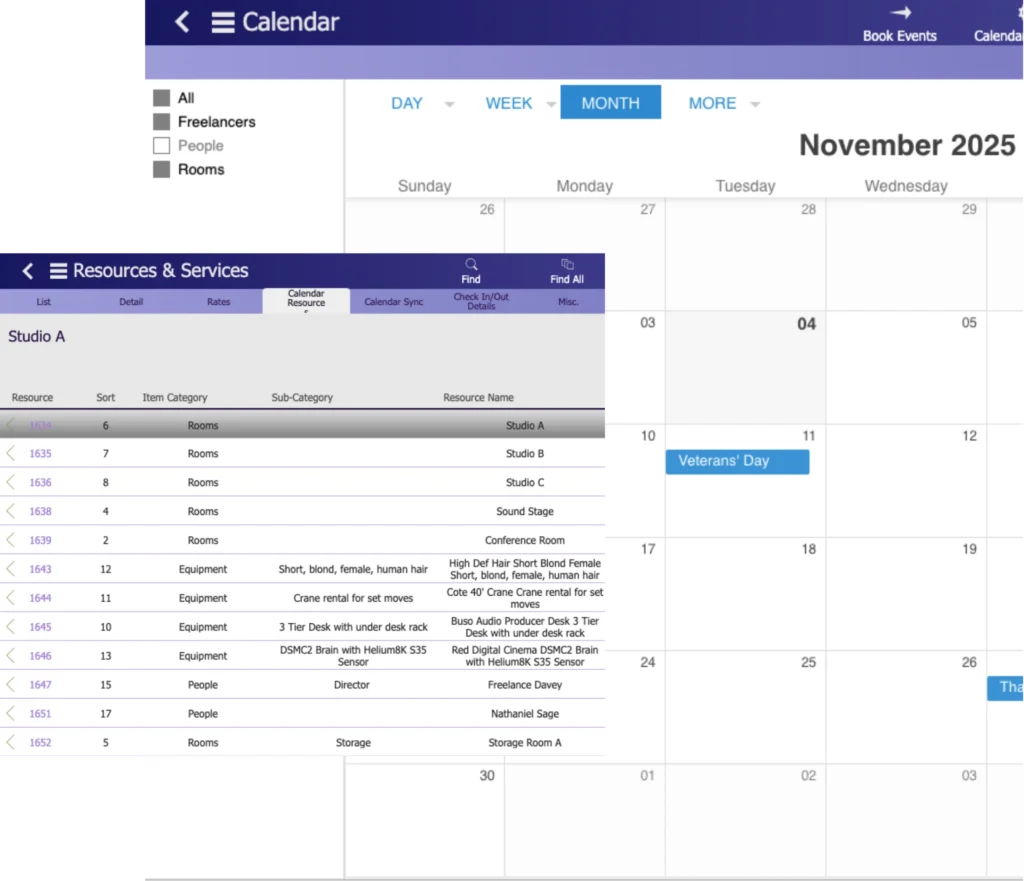
A film production crew is organized into a department-based hierarchy where every role carries defined responsibilities, reporting lines, and operational dependencies. Understanding who does what, who reports to whom, and how each department connects to the broader production workflow is essential for any studio managing crew across multiple productions. This is not just an organizational chart exercise. Crew role clarity directly determines how accurately you can schedule, budget, and manage a production from pre-production through wrap.
At Studio Hero, crew management across film and TV productions is one of the most operationally complex functions we are built to support. When you understand the full crew structure of a film production, you understand why crew management requires a dedicated system rather than a contact list and a spreadsheet.
How Film Production Crew Is Structured
A professional film production crew is organized into departments, each responsible for a specific technical or creative function. Each department has a head who reports to the Director, Producer, or Production Manager depending on their function. Below the department head is a tiered structure of specialists, assistants, and support roles.
The crew structure divides broadly into two categories that mirror the financial architecture of a production budget:
Above-the-line crew covers the creative leadership of the production. These are the roles whose fees are negotiated individually and whose creative contribution defines the project. The writer, director, producers, and lead cast sit above the line.
Below-the-line crew covers every other production role. These are the specialists, technicians, and coordinators whose work executes the creative vision within the operational constraints of the budget and schedule.
Understanding this distinction matters operationally because above-the-line and below-the-line crew are managed differently, contracted differently, and tracked differently within a studio budgeting and crew management system.
Above-the-Line Crew Roles
The Director
The Director is the primary creative authority on a film production. Every creative decision on set, in the editing room, and through post-production flows through the Director’s vision. The Director works with every department head during pre-production to establish the visual, tonal, and performance approach for the production, and executes that approach during principal photography through collaboration with the cast and Director of Photography.
The Director’s operational relationship with the production management system is primarily through the schedule. The shooting schedule must reflect the Director’s creative priorities while meeting the logistical and financial constraints established by the Producer and Line Producer.
The Producer
The Producer is the executive responsible for bringing the production into existence and delivering it to completion. On most productions there are multiple producer credits covering different functions: the Executive Producer who provides financing and high-level oversight, the Producer who manages the overall production, and the Co-Producer who handles specific operational areas.
The Producer’s operational responsibilities include budget approval, key crew hiring, distribution relationships, and overall production governance. In a multi-project studio environment, the Producer relationship with studio leadership and the studio’s operational management system is a critical governance connection.
The Screenwriter
The Screenwriter delivers the script that every other production function depends on. In development and pre-production, the writer may be actively involved in script revisions that affect the production plan. The locked script is the document from which the script breakdown, production schedule, and budget are derived, making the writer’s work the upstream dependency for the entire production workflow.
Lead Cast
Lead cast members are contracted above the line because their involvement is typically a condition of financing and their fees are negotiated individually. Lead cast availability windows directly determine the production schedule structure. A lead actor available for only eight weeks of a twelve-week shoot shapes the entire shooting schedule around their availability, with their scenes clustered into their available window.
Studio scheduling must account for lead cast availability constraints from the earliest stages of pre-production planning. Scheduling conflicts involving lead cast are among the most expensive to resolve because their availability is contractually constrained.
Production Department
The production department is the operational backbone of a film production. It is responsible for translating the creative plan into an executable production and managing the daily operational reality of a working film set.
Line Producer
The Line Producer is the senior operational manager of the production. While the Producer focuses on creative and executive responsibilities, the Line Producer owns the budget, the schedule, and the day-to-day operational management of every department. The Line Producer is the person who knows exactly where the production stands financially and schedularly at any given moment.
Effective Line Producing requires real-time visibility of committed costs, actual expenditure, crew hours, and schedule adherence across every department simultaneously. Line Producer tools and financial management workflows for film productions represent a core operational use case for Studio Hero’s budgeting and production management modules.
Production Manager
The Production Manager works under the Line Producer to manage the production office and coordinate the logistical functions of the production. On smaller productions the Line Producer and Production Manager role may be combined. On larger productions they are distinct positions with the Production Manager handling the operational detail that the Line Producer oversees at a strategic level.
The Production Manager’s daily responsibilities include crew coordination, vendor management, location logistics, travel and accommodation, and production office administration. Managing freelance crews across a complex shooting schedule is one of the Production Manager’s most demanding daily functions.
Production Coordinator
The Production Coordinator is the operational hub of the production office. Every information flow in a film production passes through the Production Coordinator at some point. Call sheets, crew lists, contact sheets, shooting schedules, purchase orders, and daily production reports are all managed, distributed, and filed by the Production Coordinator.
The Production Coordinator’s effectiveness depends entirely on having a centralized system where all production information lives. When information is fragmented across email, messaging apps, and separate documents, the Production Coordinator spends the majority of their time manually consolidating information rather than managing it. Studio operations management built on a single connected platform transforms the Production Coordinator’s role from information consolidator to information manager.
Assistant Production Coordinator
The Assistant Production Coordinator supports the Production Coordinator across all administrative and logistical functions. On larger productions multiple APCs may be assigned to specific areas such as travel, locations, or crew administration.
Production Secretary and Office Production Assistants
Production Secretaries and Office PAs support the production office team with administrative tasks, document management, and logistical coordination. They are the entry-level positions in the production department through which many production careers begin.

See StudioHero in Action
Book a personalized walkthrough for your studio.
Directing Department
First Assistant Director
The First Assistant Director is the operational manager of the film set. While the Director manages creative decisions, the First AD manages everything else. Running the set, maintaining the shooting schedule, calling departments to readiness, managing cast and crew on set, and ensuring the production meets its daily page and scene targets are all First AD responsibilities.
The First AD’s relationship with the production schedule is the most intensive of any crew member. They build the shooting schedule in pre-production, maintain it during production, and make real-time adjustments on set when the day’s plan changes. A First AD working with a connected production management system has immediate visibility of how schedule changes affect the broader production plan rather than working from a printed schedule that becomes outdated the moment anything changes.
Second Assistant Director
The Second AD supports the First AD in managing the set and takes primary responsibility for cast management. The Second AD maintains the cast movement schedule, coordinates cast arrivals and departures, manages extras and supporting artists, and distributes call sheets to cast and crew. The daily call sheet is produced by the Second AD under the First AD’s direction.
Third Assistant Director
The Third AD works on set supporting the First and Second AD with crowd management, extras direction, and logistics. On larger productions with complex set operations, multiple Third ADs may be assigned.
Set Production Assistants
Set PAs are the on-set support team for the directing department, managing communication between departments, running messages, and supporting the AD team with the moment-to-moment operational flow of the shooting day.
Camera Department
Director of Photography
The Director of Photography, also known as the Cinematographer or DP, is responsible for the visual execution of the film. The DP translates the Director’s creative vision into specific decisions about camera placement, lens choice, lighting design, and movement. The DP works in close collaboration with the Gaffer and Key Grip to execute the lighting plan and with the Camera Operator to execute the camera plan.
The DP’s equipment requirements, particularly the camera package and lens selection, are among the most significant below-the-line equipment costs on a film production. Equipment tracking for the camera department must maintain visibility of the full camera package across every shooting day, including any additional equipment brought in for specific scenes.
Camera Operator
The Camera Operator executes the camera movements and framings that the DP designs. On some productions the DP operates the camera themselves. On larger productions the DP and Camera Operator are distinct roles, with the DP focusing on the overall image while the Operator executes the specific movements.
First Assistant Camera
The First AC, also known as the Focus Puller, is responsible for maintaining focus during camera moves and adjusting the lens to match the performance. Focus pulling on a film set is a highly technical skill requiring deep knowledge of the camera system and the ability to anticipate actor movements in real time.
Second Assistant Camera
The Second AC manages the camera department’s administrative functions, including maintaining camera reports, managing media cards or film magazines, labeling footage, and supporting the First AC with lens changes and camera preparation.
Digital Imaging Technician
The Digital Imaging Technician manages the digital workflow from camera to post-production. The DIT monitors image quality in real time on set, manages the color pipeline from set to editorial, and ensures that all footage is correctly backed up and transferred. The DIT role sits at the intersection of the camera department and post-production.
Lighting and Electrical Department
Gaffer
The Gaffer is the head of the electrical department and the DP’s primary collaborator in lighting design. The Gaffer translates the DP’s lighting intentions into a practical lighting plan, manages the electrical crew, and oversees the safe installation and operation of all lighting equipment on set.
Best Boy Electric
The Best Boy Electric is the Gaffer’s second in command, managing the electrical department’s day-to-day logistics including crew scheduling, equipment management, and truck operations.
Electricians and Lighting Technicians
The electrical crew executes the lighting plan under the Gaffer’s direction, rigging, positioning, and adjusting lighting fixtures throughout the shooting day.
Grip Department
Key Grip
The Key Grip is responsible for all camera support equipment including dollies, cranes, jibs, and rigging systems. The Key Grip works closely with the DP and Gaffer to support the camera and lighting departments with the physical infrastructure they need to execute their work.
Best Boy Grip
The Best Boy Grip manages the grip department’s logistics, crew, and equipment under the Key Grip’s direction.
Dolly Grip
The Dolly Grip operates the camera dolly, executing the precise camera movements that the DP and Camera Operator have designed. Dolly operating is a specialized skill that requires both technical knowledge of the equipment and the sensitivity to match camera movement to dramatic rhythm.
Sound Department
Production Sound Mixer
The Production Sound Mixer is the head of the sound department on set and is responsible for capturing clean, usable dialogue and production sound during principal photography. The Sound Mixer designs the microphone strategy for each scene, manages the sound department, and maintains the technical quality of the audio recording.
Production sound quality directly affects post-production costs. Poor production sound requires extensive ADR recording in post-production, which adds significant time and cost to the post-production workflow.
Boom Operator
The Boom Operator operates the boom microphone, positioning it to capture clean dialogue while staying out of frame. The Boom Operator works in close coordination with the Camera Operator to maintain the optimum microphone position relative to both the actor and the camera frame.
Sound Assistant
The Sound Assistant manages the sound department’s equipment, supports the Sound Mixer with technical setup, and maintains sound reports documenting every audio recording made during the shooting day.
Related Reading:
- Crew Scheduling Conflicts in Film and Video Production
- Film Production Workflow
- Film Production Studio Operations Checklist for Multi-Project Teams
- Film Production Equipment List
Managing multiple productions, crews, schedules, and equipment? Explore Studio Hero’s film and video production management software.
Art Department
Production Designer
The production designer is the head of the art department and is responsible for the overall visual design of the film’s physical world. The Production Designer collaborates with the Director and DP to establish the aesthetic environment of the film and oversees the Art Director, Set Decorator, and all specialist art department teams in executing that vision.
Art Director
The Art Director manages the practical execution of the Production Designer’s vision, overseeing the construction, dressing, and preparation of all sets and locations. The Art Director coordinates the art department’s budget and schedule within the broader production plan.
Set Decorator
The Set Decorator is responsible for all the furnishings and decorative elements within a set. While the Art Director manages the architectural and structural elements, the Set Decorator manages everything that fills the space.
Props Master
The Props Master manages all properties used by cast during the film. Props management involves sourcing, tracking, and maintaining every prop through the production, with particular attention to continuity between takes and scenes.
Construction Coordinator
The Construction Coordinator manages the set construction team, overseeing the building of all physical sets to the specifications established by the Production Designer and Art Director.
Costume and Wardrobe Department
Costume Designer
The Costume Designer is responsible for all costumes worn by cast members in the film. The Costume Designer collaborates with the Director and Production Designer to establish the costume aesthetic for each character and oversees the wardrobe department in sourcing, making, and managing all costumes through production.
Costume Supervisor
The Costume Supervisor manages the wardrobe department’s day-to-day operations, including costume tracking, continuity management, and department scheduling. Costume continuity across scenes shot out of sequence is one of the most detail-intensive management functions on a film set.
Set Costumer
Set Costumers attend the set throughout the shooting day, managing costume continuity between takes, assisting cast with costume changes, and maintaining the condition of all costumes in active use.
Hair and Makeup Department
Makeup Department Head
The Makeup Department Head designs and manages the makeup for all cast members, working with the Director to establish the makeup approach for each character. On productions involving special effects makeup, prosthetics, or aging, the Makeup Department Head may supervise a team of specialist artists.
Hair Department Head
The Hair Department Head manages all hair styling for cast members. Like the Makeup Department Head, the Hair Department Head is responsible for maintaining consistency across scenes shot out of sequence.
Post-Production Crew
Post-production crew begins their involvement during pre-production in many cases, establishing the technical pipeline that will receive footage from set. Their primary operational period begins when principal photography wraps.
Editor
The Editor works with the Director to assemble the film from the raw footage shot during principal photography. The editorial process moves through assembly cut, rough cut, fine cut, and picture lock. The Editor is one of the most significant creative collaborators the Director has in post-production.
Assistant Editor
The Assistant Editor manages the technical infrastructure of the editorial process, including footage organization, media management, and the delivery of cut sequences to downstream departments. The Assistant Editor’s work directly affects the efficiency of media asset management through post-production.
VFX Supervisor
The VFX Supervisor oversees all visual effects work in the film, from planning VFX shots during pre-production through supervising the delivery of finished VFX from vendors in post-production. The VFX Supervisor works at the intersection of the production and post-production workflows.
Colorist
The Colorist executes the color grade of the finished film under the DP’s supervision. Color grading is the final creative pass on the image, establishing the visual tone and consistency of the film across all scenes.
Sound Post-Production Team
The sound post-production team includes the Dialogue Editor, Sound Effects Designer, Foley Artists and Recordist, Music Editor, and Re-recording Mixer. Each specialist handles a defined area of the sound post-production workflow, delivering their work to the Re-recording Mixer who combines all elements in the final mix.
Post-production studio management for a film production requires a system that tracks the status of deliverables from each post-production specialist, maintains version control across the editorial timeline, and monitors the post-production schedule against picture lock and delivery milestones.
How Crew Role Clarity Improves Studio Operations
Understanding every role in a film production crew is not an academic exercise. It has direct operational consequences for how a studio schedules, budgets, and manages productions.
Scheduling precision improves when the system knows not just that a crew member is booked but what department they are in, what their turnaround requirements are, and what their dependencies are with other departments. A First AC cannot work without a camera package. A Gaffer cannot light without an electrical crew. These dependencies are scheduling constraints that a purpose-built studio scheduling system handles automatically.
Budget accuracy improves when crew roles are mapped to rate structures that reflect the actual cost of each position. Above-the-line rates, below-the-line day rates, overtime thresholds, and buyout structures are all role-specific. Studio budgeting that connects crew roles to rate structures gives Line Producers a budget that reflects real costs rather than estimates.
Crew conflict management improves when the system knows which roles are interchangeable and which are not. A Second AD cannot be replaced by a Set PA. A Gaffer cannot be covered by a Best Boy Electric in all circumstances. Crew scheduling conflicts that understand role-level constraints surface more actionable information than conflicts that only show a person as unavailable.
Studio Hero’s crew management module is built around role-aware scheduling and budget integration, giving film production studios the operational infrastructure to manage crew at the level of detail that professional production requires. Every crew member in the system carries their role, their rate structure, their availability, and their active production commitments, so every scheduling and budget decision is made with complete information.
Conclusion
A film production crew is not a list of names and phone numbers. It is a structured operational system where every role carries defined responsibilities, specific dependencies, and direct connections to the scheduling, budget, and workflow of the production. Studios that understand this structure and manage it accordingly run tighter productions, resolve conflicts faster, and scale more effectively than those that treat crew management as an administrative function.
Studio Hero is the film and video production management platform that connects crew role management to scheduling, budgeting, equipment tracking, and production operations in one system. When your crew data is connected to your production data, every decision your team makes is grounded in the complete operational picture.
Ready to Manage Your Studio Operations?
Studios across film, podcast, recording, broadcast, and photography trust StudioHero.
Frequently Asked Questions
A film production crew is organized into the production department, directing department, camera department, lighting and electrical department, grip department, sound department, art department, costume and wardrobe department, hair and makeup department, and post-production team. Each department has a head who manages a specialist team and reports to the Director, Producer, or Production Manager depending on their function.
Above-the-line crew covers the writer, director, producers, and lead cast whose fees are individually negotiated and whose creative contribution defines the project. Below-the-line crew covers all other production roles, the specialists, technicians, and coordinators who execute the production within the budget and schedule constraints established by the above-the-line team.
The First Assistant Director is operationally responsible for running the film set on a day-to-day basis. The Director manages creative decisions while the First AD manages the schedule, department readiness, cast and crew management, and the pace of the shooting day.
The Line Producer is the senior operational manager of the production, owning the budget and schedule and managing the day-to-day operations of every department. The Line Producer maintains real-time visibility of committed costs, actual expenditure, crew hours, and schedule adherence, and is the primary point of accountability for whether a production delivers on time and within budget.
A film production crew size varies significantly by budget and scale. A micro-budget independent film may operate with a crew of 10 to 20 people. A mid-budget feature typically runs 50 to 150 crew members. A major studio production can employ several hundred people across multiple departments and units simultaneously.
Crew role structure affects scheduling because different roles carry different dependencies, availability constraints, and turnaround requirements. A shooting schedule that does not account for these role-level constraints creates conflicts that surface during production. Purpose-built crew management and scheduling systems that understand role dependencies produce more accurate and conflict-free production schedules.
SEE STUDIO HERO IN ACTION
Run every production from one place.
Coordinate schedules, crews, equipment, budgets, and projects without relying on disconnected tools.