Running one film production is operationally demanding. Running multiple film productions simultaneously from a single studio is a different discipline entirely. When multiple projects share the same crew pool, the same equipment inventory, the same facilities, and the same financial infrastructure, the margin for operational error compresses to near zero. A scheduling conflict that is an inconvenience on a single production becomes a cross-project crisis when three productions are drawing from the same resource pool.
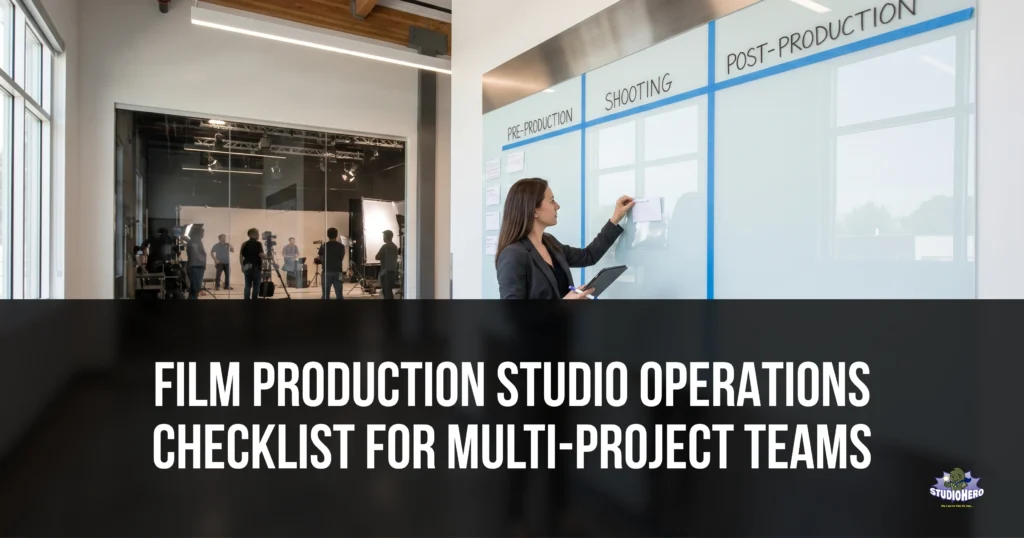
This checklist is built for studio operations managers, line producers, and production coordinators who are responsible for keeping multiple film productions running in parallel without losing visibility, control, or accountability across any of them. Every item on this checklist maps to a real operational requirement that multi-project film studios face daily.
Studio Hero is the all-in-one studio management platform built specifically for film, TV, video, and creative production teams managing this level of operational complexity. The modules inside Studio Hero are designed to make every item on this checklist a system-managed process rather than a manual effort.
Pre-Production Operations Checklist
Pre-production is where multi-project studios face their first and most consequential operational challenge. When two or more productions are entering pre-production simultaneously or in close sequence, resource conflicts that are not caught here become expensive production problems later.
Project Initiation and Greenlight
- Confirm greenlight decision is documented with approved budget frame and production timeline
- Assign a dedicated Line Producer or Production Manager to each active project
- Create a project record in your studio operations management platform before any resource allocation begins
- Confirm that the new project’s timeline does not create unresolvable conflicts with productions already in schedule
- Document project scope, delivery requirements, and key milestones at initiation
Script Breakdown and Planning
- Complete a full script breakdown before committing any crew or equipment to the production
- Identify all location requirements and flag any locations shared with other active productions
- Flag all specialized equipment requirements and cross-reference against current inventory availability
- Identify above-the-line talent and confirm contractual availability across the full production window
- Document all third-party vendor requirements and initiate sourcing early enough to avoid conflicts with other productions using the same vendors
Budget Development and Approval
- Build a complete production budget covering all five phases before pre-production resources are committed
- Separate above-the-line and below-the-line cost structures clearly within the budget document
- Establish a contingency allocation, typically 10 percent of total below-the-line budget
- Get formal budget approval from executive producers or studio leadership before below-the-line hiring begins
- Set up project-level budget tracking in Studio Hero’s budgeting module so actual spend is tracked against approved budget from day one
- Define petty cash float amounts per department and establish reconciliation frequency before production begins
Production budget approval workflows for multi-project film studios is a financial governance process that directly determines how effectively studio leadership maintains control across all active productions simultaneously.
Crew Hiring and Scheduling
- Confirm all department head availability across the full pre-production and production window before offers are made
- Cross-reference every crew hire against the studio’s master crew availability database to catch conflicts with other active productions
- Issue deal memos and contracts before crew members begin work, not after
- Document agreed rates, credit terms, and turnaround requirements for every crew member
- Build crew schedules in a centralized studio scheduling system so all productions share visibility of crew commitments
- Confirm union and guild compliance for all below-the-line crew before production begins
- Assign a production coordinator to manage day-to-day crew communication and scheduling updates for each active production
When studios manage freelance crews across multiple productions, the risk of double-booking key crew members is significant. A centralized crew scheduling system that shows all active production commitments is not optional at this level of operational complexity.
Equipment Planning and Allocation
- Complete equipment lists for each production derived directly from the script breakdown
- Cross-reference all equipment requirements against the studio’s owned inventory before initiating any rental sourcing
- Flag all equipment conflicts between simultaneous productions and resolve them before production schedules are locked
- Confirm rental equipment availability and lock in rental periods that match the production schedule
- Assign equipment to specific productions and shooting days within the equipment tracking system
- Document all equipment condition at the point of allocation with photographic records where appropriate
- Establish clear equipment return protocols and communicate them to all department heads before production begins
Shared equipment tracking mistakes between simultaneous productions are one of the most avoidable and most costly operational failures in multi-project studio environments. A piece of camera equipment assigned to two productions on the same shooting day does not become a problem at the point of conflict. It becomes a problem at the point the second production discovers it cannot shoot.

See StudioHero in Action
Book a personalized walkthrough for your studio.
Principal Photography Operations Checklist
Once production begins, the operational focus shifts from planning to real-time management. Multi-project studios running simultaneous productions need daily visibility across all active shoots, not just the one with the most urgent problem.
Daily Production Oversight
- Collect and review daily production reports from all active productions every morning
- Track scenes completed versus scenes scheduled across each production and flag any that are falling behind pace
- Monitor crew hours and overtime accumulation daily to catch budget overruns before they compound
- Review petty cash expenditure reports from all active productions and reconcile against approved float amounts
- Confirm next-day call sheets have been issued and approved for all active productions before end of business each day
- Flag any production that is more than half a day behind schedule for immediate Line Producer review
Crew Management During Production
- Confirm turnaround compliance for all crew members across all active productions daily
- Monitor crew hours against union and guild thresholds and escalate before violations occur
- Track any crew changes, replacements, or additions and update the master crew schedule immediately
- Confirm that any crew member moving between productions has adequate turnaround between assignments
- Document all on-set incidents, injuries, or safety issues on the day they occur
Crew scheduling conflicts during principal photography are significantly more disruptive in a multi-project environment because resolving a conflict on one production may create a conflict on another. Studio Hero’s scheduling tools maintain a real-time view of all crew commitments across every active production, so conflicts surface before they become set emergencies.
Equipment Accountability on Set
- Conduct a daily equipment check-in at the start of each shooting day across all active productions
- Document any equipment damage or malfunction immediately and notify the relevant department head and production manager
- Track equipment movement between units or locations in real time within the studio equipment management system
- Confirm equipment return from wrap days and update inventory records before the equipment is reassigned to another production
- Review rental equipment usage against contracted rental periods weekly and adjust as needed to avoid unnecessary extension costs
Budget and Financial Tracking During Production
- Review cost reports from all active productions weekly at minimum, daily for productions approaching budget thresholds
- Track committed costs, actual expenditure, and estimated final cost for each production in the studio’s financial management system
- Escalate any production where estimated final cost exceeds approved budget by more than five percent immediately
- Reconcile all petty cash floats weekly and replenish with proper documentation
- Process crew invoices and freelance payments within the agreed payment terms documented at the time of hire
- Track all third-party vendor invoices against purchase orders and flag discrepancies before payment is approved
Studio invoicing and financial tracking across multiple simultaneous productions requires a system that maintains clean separation between project budgets while giving studio leadership a consolidated view of the overall financial position.
On-Set Communication and Documentation
- Maintain a single point of contact protocol for all inter-production communication to prevent information from being lost across multiple channels
- Document all creative and logistical decisions that affect budget or schedule in writing on the day they are made
- Ensure all location agreements, permit extensions, and third-party contracts are updated and filed in a centralized location accessible to all relevant productions
- Distribute updated one-liners and shooting schedules to all department heads within 24 hours of any schedule change
- Maintain a production issues log for each active production and review it at the start of each production week
Centralized communication and documentation protocols for multi-project film studios is an operational framework that significantly reduces the information fragmentation that causes costly mistakes when multiple productions share resources and facilities.
Post-Production Operations Checklist
Post-production in a multi-project studio environment creates its own set of resource conflicts. Editorial suites, sound stages, color grading facilities, and VFX vendors are all finite resources that multiple productions may need simultaneously.
Post-Production Scheduling and Resource Allocation
- Build a post-production schedule for each production before principal photography wraps, not after
- Cross-reference post-production facility requirements across all active productions and identify conflicts before they affect delivery timelines
- Confirm editor availability and editorial suite access for each production across the full post-production window
- Schedule sound post-production resources, including ADR studio time, foley stages, and mixing facilities, at least six weeks in advance
- Book color grading sessions against the colorist’s availability and confirm the sessions align with picture lock dates
- Confirm VFX vendor capacity and delivery schedules before picture lock on any production that requires significant VFX work
Media Asset Management
- Establish a clear folder structure and naming convention for all digital assets for each production before footage begins arriving from set
- Confirm that all camera footage is backed up to at least two separate storage locations before the original media is cleared from set cards
- Track all deliverable assets, including picture files, sound files, VFX elements, and music stems, within the studio’s media asset management system
- Maintain version control across all edited sequences and ensure that only the current approved version is distributed to downstream departments
- Document the chain of custody for all original camera media from set through to long-term archive
Production tracking gaps in post-production, particularly around asset version control and deliverable status, are a significant source of delay and cost in multi-project studios where post-production teams may be working on multiple projects simultaneously.
Delivery and Quality Control
- Obtain delivery specifications from all distribution partners, broadcasters, or streaming platforms before post-production begins
- Build a deliverables list for each production that covers all required file formats, audio configurations, subtitle files, and metadata requirements
- Schedule quality control reviews for each deliverable against the platform’s technical specifications before submission
- Track delivery status for each deliverable in the studio’s production management system
- Confirm receipt and acceptance of all deliverables from distribution partners before closing out the production
Archive and Project Closeout
- Confirm all production assets are organized and archived according to the studio’s archive protocol before the project is closed
- Reconcile the final production budget against all invoices, receipts, and payments before closing the project’s financial accounts
- Collect all equipment, props, and production materials and update the studio’s inventory records to reflect their return
- Conduct a post-production debrief with the core production team to document lessons learned and operational improvements
- Release all crew members formally and confirm that all payments, credits, and contractual obligations have been fulfilled
Studio-Level Operations Checklist
Beyond the individual production checklists, multi-project studios need a set of studio-level operational processes that govern how all productions interact with shared resources, shared systems, and shared infrastructure.
Resource Visibility and Conflict Management
- Maintain a master production calendar that shows all active productions, their current phase, key milestones, and resource commitments in one place
- Review the master production calendar weekly with all Line Producers and department heads to surface emerging conflicts before they become operational crises
- Establish a formal resource conflict resolution protocol that defines who has authority to reallocate shared resources between productions
- Track all shared equipment, facilities, and crew commitments in a single centralized system accessible to all production teams
Studio Hero’s studio operations management platform gives multi-project studios this master visibility layer, connecting the scheduling, crew management, equipment tracking, and financial data from every active production into one operational view.
Financial Governance Across Productions
- Establish a weekly financial reporting cadence for all active productions and present consolidated results to studio leadership
- Track each production’s financial position against approved budget on a rolling basis, not just at the end of each phase
- Maintain clear separation between production budgets to prevent cost misallocation between projects
- Confirm that all inter-production cost allocations, shared crew, shared equipment, shared facilities, are documented and allocated correctly
Vendor and Supplier Management
- Maintain a preferred vendor list for all key production services, including equipment rental, catering, location services, and post-production facilities
- Negotiate studio-level agreements with key vendors that cover all active productions rather than negotiating each production individually
- Track all vendor contracts, payment terms, and performance across all active productions in a centralized contract management system
- Review vendor performance quarterly and update the preferred vendor list accordingly
Studio Operations Metrics and Performance Tracking
- Define a core set of operational KPIs for the studio that are tracked consistently across all productions
- Monitor schedule adherence, budget variance, crew utilization, and equipment utilization as minimum operational metrics
- Review operational metrics monthly at the studio leadership level and quarterly with all production team leads
- Use operational data to improve pre-production planning accuracy and resource allocation for future productions
Studio-level KPI frameworks and performance tracking for multi-project production companies is an operational governance area that separates studios that grow sustainably from those that scale reactively and pay for it in operational crises.
Conclusion
A film production studio operations checklist for multi-project teams is not a creative document. It is a risk management and operational governance framework. Every item on this checklist represents a point in the production workflow where a failure creates downstream costs, schedule delays, or resource conflicts that are expensive to resolve and entirely avoidable with the right systems in place.
The studios that manage multiple simultaneous productions with confidence are not the ones with the most talented crews or the most creative projects. They are the ones with the tightest operational infrastructure. Centralized scheduling, real-time crew and equipment visibility, structured financial tracking, and disciplined post-production management are the operational capabilities that allow a studio to scale without losing control.
Studio Hero is the film and video production management software that gives multi-project studios the operational infrastructure to manage every item on this checklist within one connected platform. From crew management and equipment tracking to studio budgeting and media asset management, every operational function a multi-project studio needs is connected, visible, and under control.
Ready to Manage Your Studio Operations?
Studios across film, podcast, recording, broadcast, and photography trust StudioHero.
Frequently Asked Questions
A film production studio operations checklist for multi-project teams should cover four core areas: pre-production operations including crew hiring, equipment planning, and budget development; principal photography operations including daily production oversight, crew management, and financial tracking; post-production operations including scheduling, asset management, and delivery; and studio-level operations including resource visibility, financial governance, and vendor management across all active productions.
Multi-project film studios avoid crew scheduling conflicts by maintaining a centralized crew availability and commitment database that is updated in real time across all active productions. Every new crew hire or scheduling change must be cross-referenced against this master record before it is confirmed. Studio Hero’s scheduling module provides this centralized visibility across all active productions simultaneously.
The biggest operational risk for multi-project film studios is resource conflict, specifically crew, equipment, and facilities being committed to two productions simultaneously without either production team being aware. This risk is eliminated by maintaining a single operational system of record that all production teams use, rather than allowing each production to manage its own spreadsheets independently.
Equipment tracking across simultaneous productions requires a centralized inventory management system that shows the status of every piece of equipment, which production it is assigned to, which shooting day it is scheduled for, and when it is due to return. Studio Hero’s equipment management module provides this level of real-time tracking across multiple concurrent productions.
Multi-project film studios should track actual expenditure against approved budget for each production on a weekly basis at minimum, with daily tracking for productions approaching budget thresholds. A consolidated financial view across all active productions should be reviewed by studio leadership weekly. Studio Hero’s budgeting and invoicing tools support both the per-production and consolidated financial views required at this level.
Post-production scheduling for each production should be completed before principal photography wraps, not after. Multi-project studios with multiple productions moving through post-production simultaneously need to secure editorial, sound, color, and VFX resources well in advance to avoid conflicts that delay delivery and trigger contractual penalties.
Studio Hero is studio management software built for film, TV, audio, video, podcast, and photography production studios. See pricing or book a free demo.