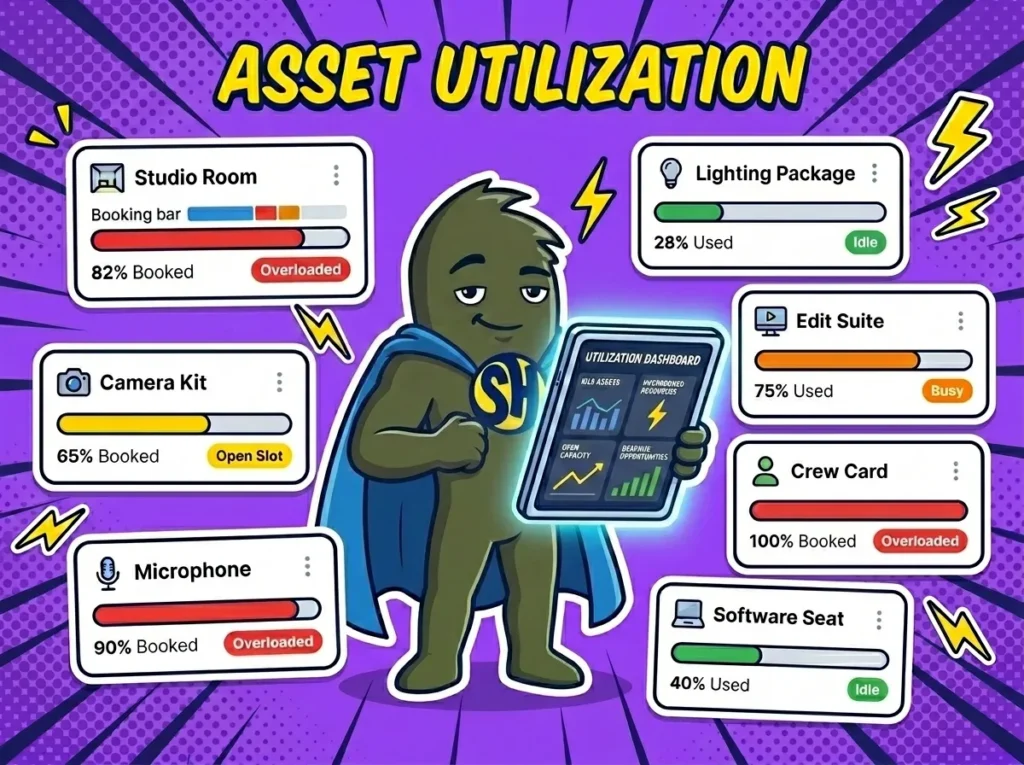
Asset Utilization is the measure of how much a studio asset is used compared with its available capacity. In studio management, it refers to rooms, equipment, crew hours, edit bays, and production resources. It helps teams spot idle assets, overbooked resources, and better revenue opportunities.
How Studios Use Asset Utilization
Asset utilization tells a studio how much value it is getting from the assets it already owns or controls. A room may be available 50 hours a week but booked only 18 hours. A camera package may sit on the shelf most days while another kit gets used on nearly every shoot. A senior engineer may be booked solid while two assistant engineers have open time.
In studio operations, asset utilization applies to spaces, gear, people, media storage, vehicles, edit bays, and software seats. The goal is not to keep every asset busy every minute. The goal is to understand which resources earn their keep, which ones create bottlenecks, and which ones need better scheduling, pricing, maintenance, or replacement.
You may also hear the term as asset usage, equipment utilization, room utilization, crew utilization, or capacity utilization. The wording changes by team, but the question stays the same: are we using the assets we pay for in a way that supports revenue and delivery?
Why Asset Utilization Matters in Studio Management
Asset utilization matters because unused capacity quietly eats into studio profit. A camera kit, vocal booth, lighting package, editing station, or producer hour may look like an owned asset, but it still carries cost. Studios pay for storage, insurance, repairs, depreciation, software renewals, and staff time whether that asset is booked or idle.
Better utilization tracking supports smarter Studio Scheduling because teams can see which assets are booked too often, which are sitting open, and where capacity can be sold.
Asset utilization helps studios:
- Find underused rooms that could support smaller bookings, rehearsals, pickups, or internal work.
- Spot gear that should be rented, sold, replaced, or promoted in client packages.
- Reduce crew overload by showing which roles are booked heavily week after week.
- Price work more accurately by tying asset use to billable projects.
- Plan purchases based on real usage instead of producer preference or guesswork.
For studio owners, utilization data turns “we need more gear” into a better question: are we using the gear, rooms, and people we already have well enough?
How Asset Utilization Works in a Real Studio Workflow
A post-production facility with eight edit suites, two color rooms, and three audio rooms uses StudioHero to measure asset utilization across client projects. The operations manager reviews the last 60 days and sees that Suite 3 was booked 82 percent of available hours, while Suite 7 was booked only 28 percent. The color rooms are nearly full, but the audio rooms have open afternoons three days a week.
Because StudioHero connects utilization with Production Management, the team can see which projects used each suite, which rooms sat open, and which bookings moved due to staff or asset conflicts. The manager notices that Suite 7 has the same edit software as Suite 3, but producers keep requesting Suite 3 out of habit.
The studio updates booking templates, trains coordinators to offer Suite 7 first for smaller edits, and creates a half-day audio cleanup package for open afternoon slots. The team also checks Inventory Management and finds that one shared monitor kit causes delays when two suites need it at the same time.
Utilization data changes the studio’s next purchase decision. Instead of buying another full edit suite, the owner buys a second monitor kit and updates room packages. That solves the real bottleneck and keeps more billable hours on the calendar.
Common Mistakes Studios Make With Asset Utilization
Asset utilization gets messy when studios count bookings but ignore the assets behind them. A room may look busy, but the gear inside may barely be used. A kit may appear profitable, but only because repair time, setup time, and downtime are not tracked.
Common mistakes include:
- Measuring only room bookings while ignoring equipment, crew, edit bays, drives, and prep time.
- Treating high utilization as good even when it causes burnout, rushed resets, or missed maintenance.
- Keeping low-use gear because nobody has reviewed its cost, repair history, or revenue.
- Buying more assets before checking whether current assets are blocked by scheduling habits.
- Forgetting non-billable use, such as testing, training, internal edits, prep, and maintenance.
Healthy utilization is not about pushing every asset to its limit. Studios need enough usage to justify cost, enough slack to handle change, and enough visibility to make better booking and buying decisions.
How StudioHero Helps Studios Manage Asset Utilization
StudioHero is an all-in-one studio management software that helps studios see how rooms, equipment, crew time, and production resources are being used. Instead of looking only at a calendar, teams can connect asset use with bookings, projects, clients, costs, and billing.
StudioHero helps teams manage asset utilization through:
- Studio Scheduling that shows booked time, open time, room demand, holds, and capacity.
- Equipment Tracking that records how often gear is checked out, returned, missing, damaged, or reserved.
- Inventory Management that helps teams compare owned assets with actual usage and replacement needs.
- Production Management that connects asset use with shoots, sessions, tasks, approvals, and delivery work.
- Studio Budgeting and Studio Invoicing that help teams connect asset use to project cost, billable work, rentals, and margin.
Frequently Asked Questions
What does asset utilization mean in a studio?
Asset utilization means how much a studio asset is used compared with how much it could be used. The asset might be a room, camera kit, microphone, edit suite, crew role, storage system, or software seat. Studios track utilization to see which assets are busy, which ones sit idle, and which ones may need better scheduling, pricing, repair, or replacement.
How do studios measure asset utilization?
Studios usually measure asset utilization by comparing used time with available time over a set period. For example, if a room is available 40 hours a week and booked for 30 hours, its utilization is 75 percent. For equipment, teams may track check-outs, booking days, rental days, repair days, and idle days. The best measure depends on the asset type.
What is a good asset utilization rate?
A good asset utilization rate depends on the studio, asset, and service model. A high-demand vocal booth may need heavy booking to pay for itself, while a specialty camera lens may be valuable even if used less often. Very high utilization can also create problems if there is no time for cleaning, testing, setup, repair, or schedule changes.
What is the difference between asset utilization and asset availability?
Asset availability tells you whether an asset is free and ready to use at a specific time. Asset utilization tells you how much that asset is actually used over time. A room can be available today but still have high utilization across the month. A camera can be available now but still underused across the quarter.
What software helps studios track asset utilization?
StudioHero helps studios track asset utilization by connecting scheduling, equipment tracking, inventory records, production work, budgeting, and invoicing. Studios may also use spreadsheets, calendar reports, barcode systems, rental logs, or accounting tools. The stronger setup links each asset to real bookings, billable hours, repair time, and client work.